Everything You Should Know About Psychiatric Nursing
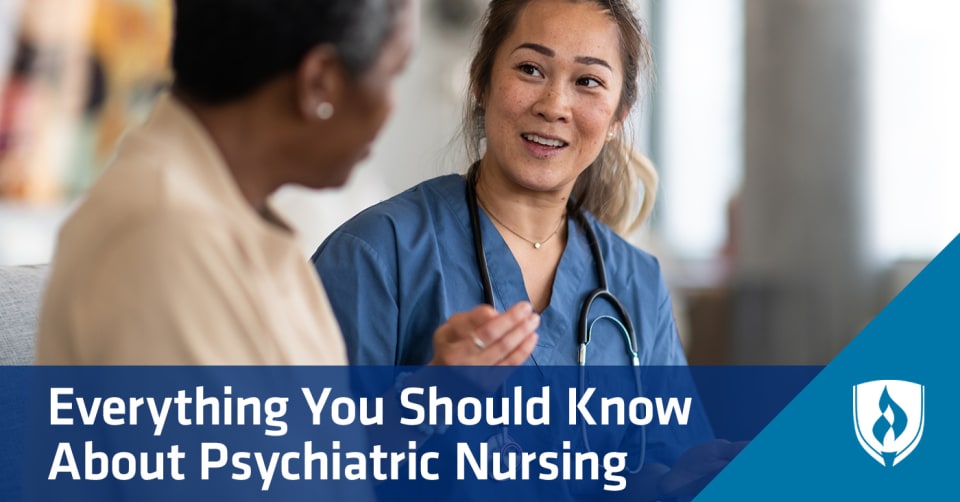
Psychiatric nursing is unlike any other kind of nursing. You cannot fix depression like you fix a broken leg, and the rest, ice, elevation and compression method isn’t going to do much for recurring panic attacks. But as a psychiatric nurse, you can offer the understanding and empathy a patient needs to begin healing.
Mental illness is arguably one of the most challenging illnesses to treat. It’s tough to detect for many and while attitudes are shifting, some still attach a stigma to seeking treatment. Add in the fact that there is not always a clear, uniform path to recovery, and it’s easy to see how psychiatric nursing can bring some unique challenges—and rewarding moments.
In this article, we’ll dive into the details of psychiatric nursing. This includes a look at the different roles within psychiatric nursing, what their duties are, where they work, the types of illnesses they commonly treat and which skills are essential in order to thrive in this nursing specialization.
Get Your Nursing School Questions Answered at a Nursing Information Session
Types of psychiatric nursing roles
If you’re interested in working in a psychiatric nursing unit, you should know that there are two primary paths:
- Working as a psychiatric registered nurse (RN)
- Working in advanced roles like psychiatric nurse practitioner or psychiatric / mental health advanced practice registered nurses (APRN)
Becoming a psychiatric registered nurse
In order to become a psychiatric registered nurse, you will first need to earn either an Associate’s degree in Nursing or a Bachelor of Science in Nursing (BSN). From there you’ll need to pass the NCLEX-RN licensure examination to become a registered nurse (RN). It should be noted that while both degrees are viable options for becoming an RN, some employers may strongly prefer candidates with a bachelor’s degree or have the expectation that you complete a bachelor’s degree within a certain number of years after being hired. If you’re set on becoming a psychiatric nurse, you may want to ask employers in your area about their preferences.
Looking for more information? Check out “ADN vs. BSN:您的指南,帮助您决定护理学位。”
Once you’ve passed your licensure examination, you’ll likely want to spend some time building nursing experience before applying to psychiatric nursing roles. That said, it’s not unheard of to find one of these positions available to new graduates.
Though it is possible to work in psychiatry without certification, you may want to pursue certification in psychiatric-mental health nursing.The American Nurses Credentialing Center(ANCC) offers a certification exam to those who have:
- An active RN license
- Practiced two years full time as a registered nurse
- 精神科护理中至少有2,000小时的临床实践
- Completed 30 hours of education in psychiatric-mental health nursing
Advanced practice and postgraduate psychiatric nursing
Advanced practice registered nurses (APRNs) and nurse practitioners (NPs) both have expanded scopes of practice when compared to psychiatric RNs. That said, things get a little more complicated at this level and the best route for you will depend heavily on the state in which you wish to practice—currently state laws are not uniform regarding scope of practice, education and licensure requirements.
That being said, as with psychiatric registered nursing, you will first need to obtain your RN license. Because the next step is graduate school, aBachelor’s degree programis the ideal first step—though there are options likeaccelerated BSN programsif you have an unrelated Bachelor’s degree orrn-to-bsn程序for ADN-RNs looking to make the jump.
完成学士学位注册护理教育后,您将很可能需要花时间在精神病注册护理(或密切相关)的角色,因为许多毕业生护理计划都需要这项录取。一旦您获得了验收并完成了您的计划,您需要完成认证考试并追求许可证,如果您的州要求它。应该指出的是,一些国家可能要求护士从业人员完成护理练习博士(DNP)。
What are some common psychiatric nursing duties?
Depending on which path you choose, your职责will vary. As a psychiatric nurse, you can expect to meet with patients to discuss and note symptoms, implement care plans, administer medications, update patient charts, assist in basic needs, facilitate group therapy projects and more.
As a psychiatric nurse practitioner or APRN psychiatric nurse, you will be more involved in the process of diagnosing, creating treatment plans and offering psychotherapy. Insome states, APRN and NP psychiatric nurses may be allowed to prescribe medication.
Where do psychiatric nurses work?
As with other medical professions, your options includeinpatient and outpatient care。Inpatient care refers to places where a patient is admitted such as a hospital or psychiatric facility. Outpatient care typically refers to patients seen in their own homes or local clinics. While psychiatric registered nurses and advanced practice psychiatric nurses can work in both settings, advanced practice psychiatric nurses are typically more独立的并能使用wider variety of patients on their own, making outpatient care a more common option.
What conditions do psychiatric nurses treat?
Psychiatric nurses will work with patients with a wide variety of disorders and mental illnesses with symptoms that may manifest in surprising ways. Here are a few common areas psychiatric nurses encounter regularly in their work.
- Mood disorders:Depressionandbipolar disorderare two of the most common mood disorders. People with this type of illness may experience extreme feelings of apathy, worthlessness, emptiness, fatigue and sadness. In the case of bipolar disorder, they may also experience cases of extreme mania, not sleeping for days and losing the ability to think clearly.
- 精神病疾病:People experiencingpsychosismay have auditory and visual hallucinations that can range from strange to serious. This includes patients with schizophrenia and substance-induced psychotic disorders.
- 失智disorders:失智是指内存,加工和语言等心理能力的一般损失。阿尔茨海默氏症是这种疾病的一种常见形式,最常发生在老年人口中。因此,许多患有这种疾病的患者将有其他身体需求和残疾。
- 饮食障碍:Though these disorders cause significant physical issues, they are primarily a mental illness. People with these diagnoses often have an unrealistic view of their self-image, resulting in dangerously unhealthy behavior. Common eating disorders include anorexia, bulimia and binge eating disorder. Often these disorders go hand in hand with other mental health issues.
- Addiction disorders:Addiction to drugs, alcohol or certain behaviors can cause several other mental health issues, including psychosis and depression. There are许多层数治疗这种类型的疾病,包括症状(身体和心理),撤回和成瘾的初始原因。
什么技能为一个好的精神护士进行?
- 沟通:As a psychiatric nurse, you will have to practice active listening a lot. In order to feel validated and safe, most patients just need to feelheard。This can be a difficult skill to master when what a patient is saying does not line up with reality. If they are hallucinating or spiraling, you must be able to find out exactly what they are thinking in order to help them cope. This requires keen attention, interpretation and overall good communication skills.
- Observation:精神科护理有时会感到像一个不可预测的风暴。一刻,病人似乎可以 - 也许是他们改善。下一刻,他们需要克制自己或他人。虽然并非所有患者都存在暴力风险,但保持敏锐性是重要的。如果您可以学会阅读人们进行微妙的痛苦迹象,您可能能够在议案升级之前帮助它们。
- Self-care:In order to care for others, you must be able to care for yourself. Nursing can be physically and emotionally taxing—and that’s especially true for psychiatric nurses. When it comes to doing this job effectively long-term, it is important to stay both mentally and physically healthy.
Be a light in the dark
Psychiatric nursing can be a difficult career. Not every patient will get better, and some days will be chaotic. But pursuing psychiatric nursing could also be one of the most rewarding decisions you’ll ever make.
If you’d like to take the first step toward a psychiatric nursing career, visit theRasmussen College School of Nursing page。Interested in exploring other nursing options? Start with our article “Top 25 Types of Nurses Employers Are Looking to Hire。”